 For Jeep Wrangler
 Customizable modules

-
Upload photo
Re-upload
Accepting: jpg, png. Max file size: 10 MB
Buyer's Guide: 4 Best Aftermarket Car Headlights for Replacement
The automotive aftermarket is set for growth in the years ahead,, with headlights a must-have component.
In a recent report on the overall aftermarket for light vehicles, McKinsey outlines two forecast scenarios, a ‘base case’ and an ‘accelerated’ forecast. The base-case scenario sees nearly 50 percent growth in the combined aftermarkets of China, the European top four (UK, Germany, France, and Italy), and the United States, rising from $463 billion in 2019 to $675 billion in 2030. In the second scenario, trends toward shared mobility and electrification, among others, accelerate and reduce the size of the market to $588 billion in 2030—still representing a growth of approximately 30 percent in market size compared to 2019.
FAQs about Aftermarket Car Headlights Replace
Why Consumers Replace Headlights
There are a number of reasons to replace headlamp assemblies, explains Richard Reina of parts distributor CARiD. “Plastic outer lens covers on composite headlights deteriorate over time as they are sandblasted by road grit. Milky-looking "cataracts" form on once-clear lens covers as acid rain and sun take their toll and chemically change the plastic. Heat from the sun and humidity in the air cause wiring inside the headlight housing to corrode from within - building up electrical resistance. Combine hazy cataracts on the lens covers with the reduced electrical flow, and you've got much dimmer light output.”
There are two major categories of headlight replacement: getting a new version of the stock part the vehicle was shipped with originally, known as an “OEM replacement”, or installing a different design for performance or style reasons.
What Does OEM Mean for Cars?
Vehicle manufacturers use OEMs (Original Equipment Manufacturers) to supply the parts to build a new vehicle. “These OEMs are not just the suppliers but also the designers of the first parts that are fitted in the new vehicles,” explains a report by Welsh automotive parts manufacturer TRW. “For example, if Ford uses, say, Autolite spark plugs, Exide batteries and Ford's own engine blocks and heads when building a car, then car restorers and collectors will consider those components to be the OEM parts. Some of these OEMs, such as TRW, also produce parts for the automotive aftermarket so that workshops can fit vehicles with parts that are made with the same high standards and expertise that created the original parts.”
New OEM headlamp assemblies can increase the resale value of a vehicle, explains Reina. Replacing of a set of milky-looking headlamps can bring an increased sale price that offsets the upfront purchase.
Car Headlights Replacement for A Stylish New Look
Many vehicle owners want to change the appearance of their car or truck when they replace headlights. Owners of vehicles with vibrant colors, decals, or custom paint work prefer headlamp assemblies with chrome background bezels, according to Reina, “while those with matte finishes had the highest likelihood of being satisfied with "smoke" (tinted) headlight assembly colors. And those with solid colors (especially black) often preferred the look of clear headlight lenses with black background bezels.”
Xenon HID vs Halogen Bulbs: What's the Real Difference
Halogen headlights use traditional bulbs with incandescent filaments to produce light, while HID (high-intensity discharge) bulbs use a mix of metallic salts heated to a gaseous state with a small amount of xenon gas to produce brighter light, but at a higher price point. Because the wiring connectors for halogen and HID lights are not compatible, buyers should stay with the same style that was originally equipped on their specific vehicle.
Your Guide to LED Headlights – What you Need to Know
Compared to halogen bulbs, LED headlights are brighter, last longer and use less energy. They also look good, a draw for many end-users.
But buyers should be careful. “Many inexpensive LED conversion kits have a high lumen count but nothing else,” says Richard J, product manager at automotive lighting manufacturer OPT7.
While lumens help determine how an LED will perform, Richard continues, buyers must consider the unit’s lux - the measurement of lumens per square meter – and CRI. Lux defines the bulb’s intensity and how far it will shine. CRI (color rendering index) is a measurement of the ability of a light source to accurately reveal the colors of an object, on a scale from 1 to 100. A high CRI rating allows for brighter output with the same lumens. “If a LED headlight fails to even mention these other key metrics, it’s probably a sign that they don’t really care about them.”
OPT7 also warns against overclocking. “There’s a reason product isn’t overclocked from the factory – the process creates extreme heat and decreases lifespan.” A cheaper LED unit may feature an overclocked chipset that allows it to produce a high lumen count for short time but will soon overheat and fail.
Finally, buyers should ensure that LED headlight assemblies are using chipsets specifically designed for automotive use. General-use chipsets simply aren’t up to the demands of automotive applications.
Are LED Headlights Legal in the US, UK?
Not all headlamps are permitted in every jurisdiction and even allowed products will require certifications.
For example, in the UK, since January 2021 the MOT inspection manual – used to determine whether a vehicle is permitted to keep using British roads – has been updated to state that “halogen headlamp units should not be converted to be used with high-intensity discharge (HID) or light emitting diode (LED) bulbs. If such a conversion has been done, you must fail the headlamp.”
In the US, meanwhile, if your company imports equipment covered by a Federal Motor Vehicle Safety Standard (FMVSS), which includes lighting, you must register with the National Highway Traffic Safety Administration and conform to the relevant standard.
Finding the Right Light among 4 Best Headlights– or Making to Measure
Whether seeking a new style or one-for-one replacements, it’s crucial that new lights fit the vehicles they’re destined for. When searching for products on GlobalSources.com, look for the model or brand name, but bear in mind that it is worth inquiring with suppliers who don’t list the exact model you want – custom offerings are often available, though of course economies of scale mean that a smaller custom order will usually have a higher per-unit price.
Gallery View of Fabulous Car Headlights from Verified Suppliers
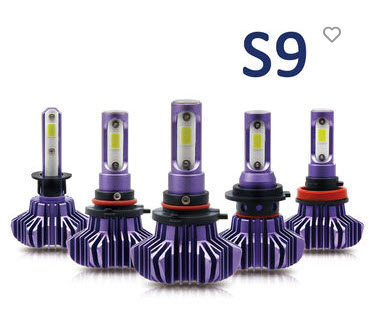
Company: Sun Rising Enterprise Co. Ltd
The S9 type of the model PD-082106 automotive headlight bulb from Sun Rising Enterprise Co. Ltd is fanless, for a longer lifespan, and IP67 waterproof. It uses Bridgelux-COB LEDs to provide 6000 lumens at a color temperature of 6500K. A range of customization options are available, with no minimum order.
Company: Zhejiang NAC Hardware & Auto Parts Dept.
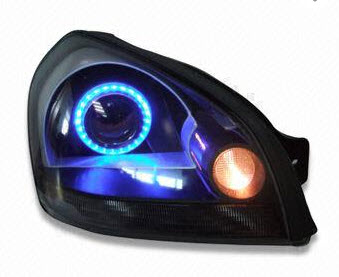
The ZAN10-3 from Zhejiang NAC Hardware & Auto Parts Dept. is an “angel eye” design bi-xenon headlight with anti-fog technology. The stock product depicted here fits a variety of cars including the Honda Accord and Toyota Corolla, but OEM orders are accepted. Lead time is 20-30 days, with a minimum order of 100 sets.
Company: Hangzhou Green Offroad Auto Parts Co., Ltd
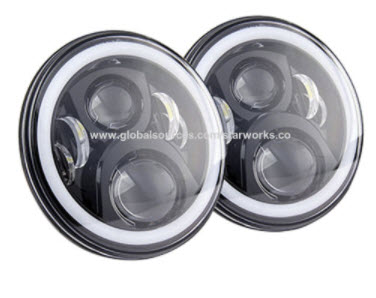
Hangzhou Green Offroad Auto Parts Co., Ltd’s JK-129 is a set of round 7in LED headlights for the Jeep Wrangler, motorcycles and other vehicles. The product uses Cree LED chips and is available with a black or chrome bezel, with daytime running light color options of white or white & yellow. The MOQ is four sets, with a lead time of 7 to 15 days.
Company: Changzhou Yuanfa Electronic Lighting Technology Co. Ltd
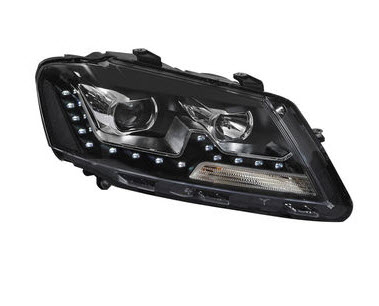
The EOFA LY-EOFA-058 from Changzhou Yuanfa Electronic Lighting Technology Co. Ltd is a headlight assembly designed for the Volkswagen Lavida available with the buyer’s choice of HID, LED, and bi-xenon projector modules, in addition to the stock H1 halogen lamp for the upper beam and PY21W halogen bulbs for turn signals. Lead time is 20 days for a bulk order, seven days for a single set.
People Also Like:
Ultimate Guide to China Sourcing
Sole Sourcing vs Single Sourcing vs Multiple Sourcing Category
Ultimate Guide: In-Depth Insights on Global Sourcing
Minimum Order Quantity (MOQ) Explained - Formula & Tips
How to Find a Manufacturer or Supplier For Your Product
Source the latest products from verified suppliers via global sourcing platform, and subscribe to our magazines for more in-depth insights and product discovery.
Join the Smart China Sourcing Facebook Group
- Connect with other buyers
- Ask questions
- Get advice from experts
The Related News
![]()
![]()
![]()
![]()
Serger vs Sewing Machine: Key Difference
2023/09/08